

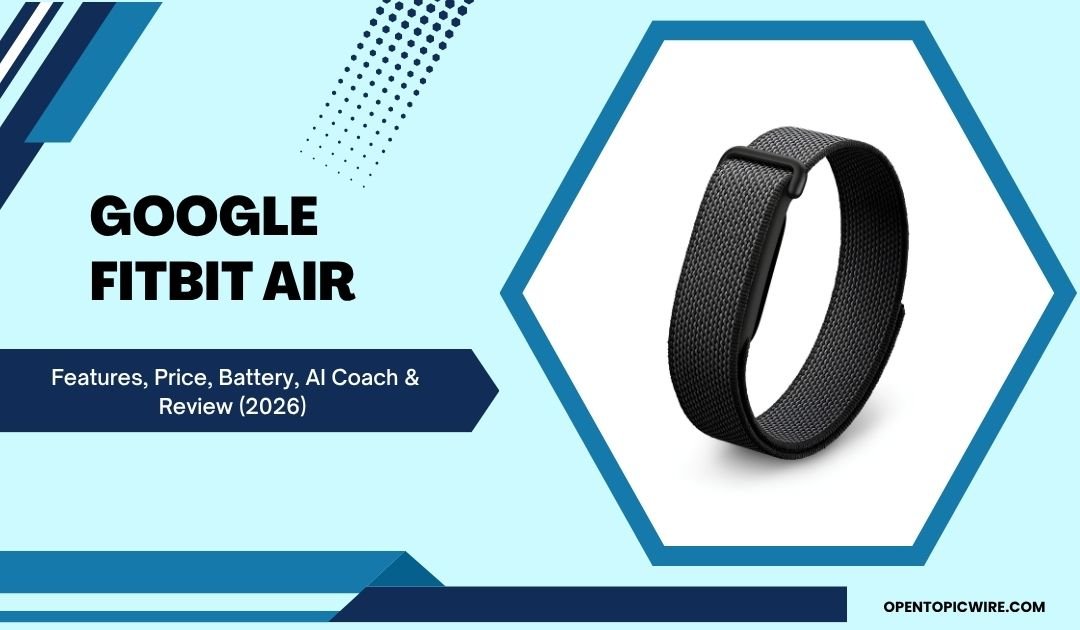
The Google Fitbit Air is a 24/7 fitness tracker band — but not the kind you’re used to. There’s no screen, no buttons, no on-wrist controls. Instead, a tiny “pebble” sensor sits quietly on your wrist, continuously collecting health data that surfaces through the Google Health app (the renamed Fitbit app). For $99.99, it’s built for people who want passive health tracking without the bulk of a smartwatch.
Quick Facts
| Price | $99.99 (standard) / $129.99 (Stephen Curry Special Edition) |
| Display | None |
| Battery life | Up to 7 days (7–9+ in real-world testing) |
| Charge time | ~90 minutes full charge; quick charge = ~1 day |
| Water resistance | 5 ATM (50 m) |
| Weight | 5.2 g (sensor only), ~12 g with band |
| GPS | None on-device — requires phone |
| Release | Pre-order May 7, 2026 · General availability May 26, 2026 |
What Is the Fitbit Air?
It’s Google’s smallest, lightest tracker yet — a plastic sensor module measuring 1.4 × 0.7 × 0.3 in (34.9 × 17 × 8.3 mm), clipped into interchangeable bands. With no display or haptic buttons, it runs entirely in the background, monitoring:
- Heart rate
- Sleep
- Activity
- SpO2 (blood oxygen)
- Skin temperature variation
Data syncs via Bluetooth to the Google Health app (Android and iOS). A vibration motor handles two things only: Smart Wake alarms and low-battery alerts — no phone notifications appear on the device itself.
Key Features
Health & Fitness Tracking
- Continuous optical heart-rate monitoring + resting heart rate
- Heart-rate variability (HRV)
- Irregular rhythm notifications, including AFib alerts
- Overnight SpO2 and skin temperature tracking
- Steps, Active Zone Minutes, automatic workout detection, calorie tracking
- Sleep stages, sleep length, and Smart Wake
- Temperature-based cycle tracking for women (reviewers note this area still needs improvement)
Sensors
Optical heart-rate sensor · 3-axis accelerometer · 3-axis gyroscope · Red/infrared SpO2 sensors · Skin temperature sensor · Vibration motor
Google Health App & Gemini AI Coach
This is the headline feature. Basic metrics are free; the Google Health Premium subscription unlocks the full Gemini-powered AI Coach, which can:
- Build individualized exercise programs
- Factor in sleep and readiness data
- Answer health questions using your own data
- Log workouts via text, photos, or voice
- Proactively suggest adjustments
Also included free with a Google AI Pro or Ultra subscription.
Daily Readiness Score
A free feature (no subscription needed) that scores your recovery each morning from 0–100:
| Score | Meaning |
| 65+ | High readiness |
| 30–64 | Moderate readiness |
| ≤29 | Low readiness |
It’s calculated from recent sleep, resting heart rate, and HRV relative to your personal baseline.
GPS Limitations
There’s no built-in GPS. To get accurate distance, pace, and route data outdoors, you must carry your phone and start the workout from the Google Health app. Without a phone, the tracker relies on estimating from motion sensors alone — reviewers found this notably less accurate for running and walking. Elevation data is phone-dependent too. This trade-off is what keeps the device small, light, cheap, and battery-efficient.
Design
| Detail | Spec |
| Sensor weight | 5.2 g |
| Total weight (with band) | ~12 g |
| vs. Fitbit Luxe | ~20% lighter |
| vs. Whoop band (~27g) | Notably lighter |
| Wrist size range | 130–210 mm |
| Colors | Obsidian, Fog, Lavender, Berry, Stephen Curry Special Edition |
| Bands | Performance Loop included; textile & silicone options from $34.99 |
Reviewers consistently describe it as comfortable enough to forget you’re wearing it, day and night.
How to Connect the Fitbit Air
- Install the Google Health app on your Android or iOS device
- Turn on Bluetooth on your phone
- Charge the tracker on its magnetic USB-C cradle
- Open the app and sign in with your Google account
- Add a new device and select “Fitbit Air” from the list
- Pair the tracker by following the on-screen instructions
- Grant permissions — Bluetooth, notifications, activity, and health data
- Let it sync — your data will start appearing in the app
Price & Subscription Plans
| Item | Price | Notes |
| Fitbit Air (standard) | $99.99 | Includes Performance Loop band + 3-month Premium trial |
| Fitbit Air (Stephen Curry Edition) | $129.99 | Same sensors, different finish |
| Accessory bands | From $34.99 | Textile and silicone options |
| Google Health Premium | $9.99/mo or $99.99/yr | Optional; free with Google AI Pro/Ultra; 3 months free with device |
| Charging cradle | Included | Magnetic USB-C |
Bottom line: Core health and fitness tracking is free forever. You only pay for the full AI Coach, adaptive plans, and deeper insights.
Sensors, Tracking Depth & User Experience
- Everyday accuracy: Solid for daily activity and moderate exercise; Google itself acknowledges it’s not as sophisticated as Pixel Watch sensors during extreme workouts.
- Sleep tracking: Rated highly by independent lab comparisons for both sleep stages and sleep duration.
- Workout detection: Best at catching high-intensity exercise like running; low-intensity walking is detected less reliably.
- Readiness Score: Pairs naturally with the Coach’s morning summaries for recovery-based plan adjustments.
- No screen, by design: You check in via the app rather than glancing at your wrist — freeing for some, limiting for anyone who wants real-time pace or heart-rate zones mid-workout.
- Works alongside a Pixel Watch: The app lets you choose which device’s data to use, useful for splitting tasks between devices.
Pros and Cons
| Pros | Cons |
| Light and comfortable for extended wear | No onboard GPS — phone required outdoors |
| $99.99 with no subscription required for core features | No ECG, no notifications, no time display |
| Accurate sleep, heart rate, SpO2, and readiness data | Premium subscription needed for full AI features |
| Strong Gemini-powered AI wellness coaching | Heart-rate sensor weaker during high-intensity workouts |
| Full week of battery life, fast charging | Automatic activity/distance detection has caveats |
| Works with both Android and iOS | |
| Clean, distraction-free design |
How It Compares
| Feature | Fitbit Air | Whoop | Apple Watch |
| Price | $99.99 | From $199/year membership | Higher upfront cost |
| Display | No | No | Yes |
| GPS | None (phone-dependent) | Connected/limited | Built-in |
| Battery | Up to 7 days | Up to 14 days | Typically 1–2 days |
| Health tracking | Strong | Advanced recovery focus | Extensive |
| AI coaching | Gemini-powered | — | Apple Intelligence |
| Best for | Passive health tracking | Athletes & recovery | All-in-one smartwatch |
In short: Fitbit Air wins on affordable, distraction-free tracking. Whoop suits serious recovery/training data. Apple Watch is best for an all-in-one smartwatch experience.
Honest Review
The Fitbit Air succeeds at its core mission: quietly gathering rich health data and presenting it clearly, without the bulk of a watch or the noise of notifications. If you don’t want anything on your wrist that beeps, buzzes, or demands attention, this is one of the strongest “set it and forget it” trackers available in 2026. Sleep tracking, the Daily Readiness Score, and the conversational Gemini Health Coach stand out as its best features — and at $99.99 with no mandatory subscription, it undercuts competitors that lock core tracking behind a paywall.
It’s not for everyone, though. Skip it if you need:
- Precise standalone GPS for running or hiking
- At-a-glance stats on your wrist
- ECG capability
- A full smartwatch experience
Recommendation
| If you want… | Consider… |
| Lightweight, all-day health & sleep tracking with light AI support | Fitbit Air |
| A secondary tracker alongside a smartwatch | Fitbit Air |
| Serious GPS-dependent training data | Look at Garmin or Whoop instead |
Conclusion
Google’s Fitbit Air takes a deliberately low-tech approach: no screen, all focus on data. For anyone who wants personalized health insights without smartwatch clutter, its sleep tracking, heart-rate monitoring, Daily Readiness Score, week-long battery, and Gemini-powered coaching make a compelling case at $99.99. Serious athletes may find the lack of onboard GPS, ECG, and real-time display limiting — but for everyday health tracking, it’s one of the more thoughtful wearables of 2026.
FAQ’S
A tiny, screen-free wearable that tracks health, fitness, and sleep 24/7.
$99.99 standard; $129.99 for the Stephen Curry Special Edition.
No you need your phone nearby for accurate distance, pace, and route tracking outdoors.
No, not for core tracking. A Google Health Premium subscription is only needed for the full AI Coach experience and deeper analysis.
Rated for 7 days; real-world use shows 7–9+ days.
Also Read
Garmin Forerunner 70: Price, Launch Date, Specs & Comparison Guide
Sources
- Google Blog — Stephen Curry Special Edition Fitbit Air launch
- Forbes — Google Debuts The Fitbit Air, a $99 Screen-Free Tracker
- 9to5Google — Fitbit Air Review
- 9to5Google — Stephen Curry Edition coverage
- Thurrott.com — Google Fitbit Air Review
- The Gadgeteer — Fitbit Air launch details & pricing
- The Gadgeteer — Colors, availability, specs confirmed via retailers
- Big Apple Buddy — Stephen Curry Special Edition review